 Albuquerque Swamp Cooler Repair
 Swamp Cooler Repair in Albuquerque
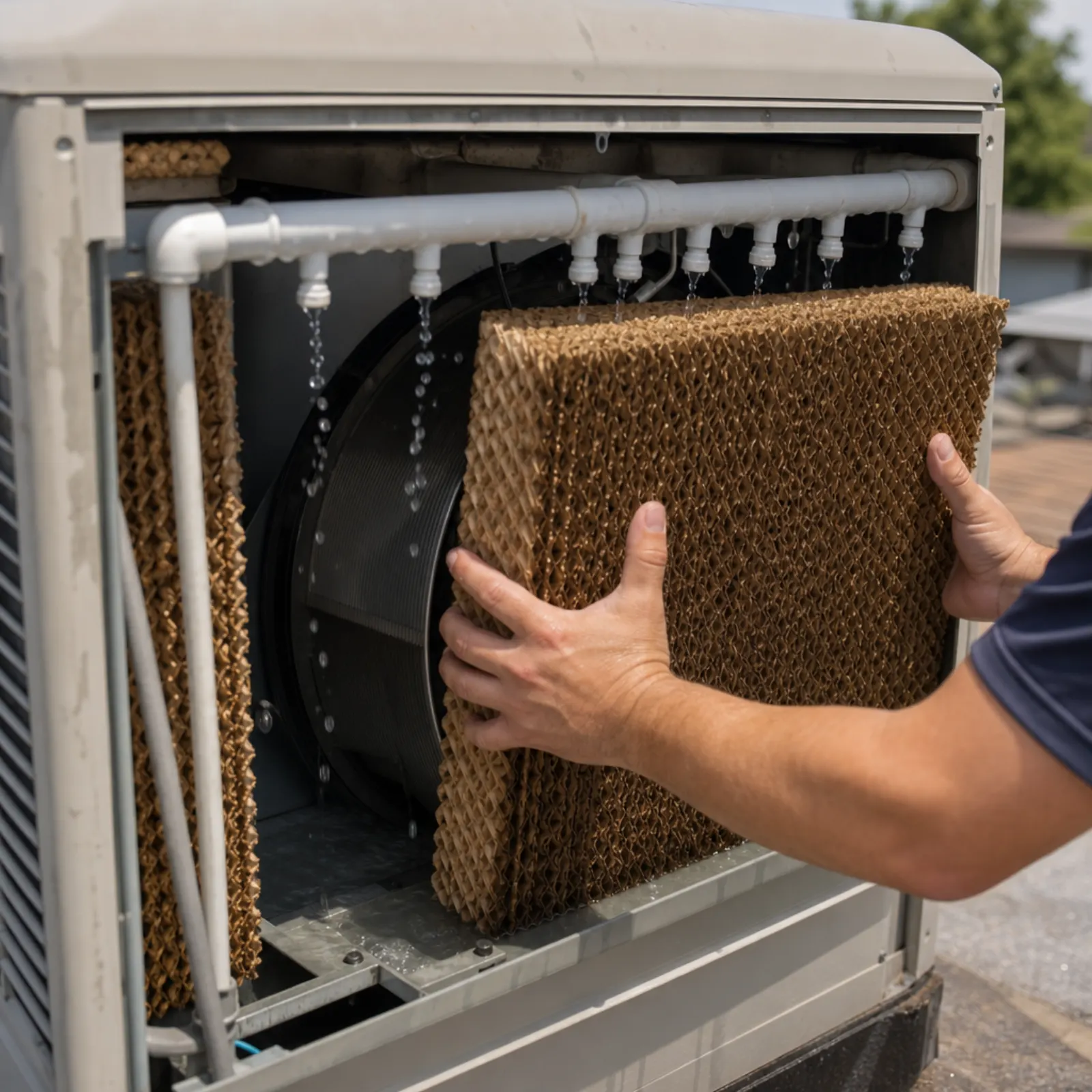
Swamp cooler repair in Albuquerque runs $150 to $350 for the service call, which puts one of our techs on the roof, covers the diagnosis, and includes the first hour of labor. Most repairs are finished on that visit: a pump adds $150 to $400, a float $100 to $250, a belt $40 to $100, a motor $300 to $700. Send a photo of the cooler with a side panel off and a sentence about what it is doing, and you get a diagnosis and a number before anyone drives.
Coolers fail in predictable ways, and in this metro they fail for two predictable reasons: hard water and skipped shutdowns. The rest of this page is what we look for, by symptom, and what it costs to fix.
Warm air with the blower running
The most common call from June through August. The blower is moving air, but the air coming out of the vents is barely cooler than the porch. That means the pads are dry, and the question is why.
- Pump dead or clogged. The submersible pump sits in the pan and lifts water to the distribution tubes. It dies from scale on the impeller, from running dry when the float sticks, and from a season of sediment. Third-party compilations of the Water Authority’s 2024 zone reports put Albuquerque’s average hardness at 141 milligrams per liter, about 8.2 grains per gallon, and Rio Rancho’s aquifer water at about 180. Every gallon that evaporates leaves that mineral in the pan. Pump replacement is $150 to $400 installed, sized to the cooler’s CFM.
- Float stuck or mis-set. No water in the pan means no water on the pads. A float is $100 to $250.
- Distribution tubes blocked. Scale closes the small holes in the spider tubes and one or two pads run dry while the rest are fine. Cleared or replaced with the visit.
- Pads crusted. A pad so loaded with mineral it cannot hold water is not a pad anymore. Aspen sets are $80 to $200, rigid media $300 to $700. The pads, pumps, floats, and motors page covers when to choose which.
- Water supply off. It happens. The shutoff at the hose bib got closed, or the line froze last winter and someone capped it. That is a free fix.
Before any of that, we check whether the air outside is the problem. The North American monsoon reaches New Mexico in early July, and Albuquerque’s monsoon season runs into early September. University of Arizona researchers writing in Southwest Hydrology put it in one sentence: when outside air is already moist, the effectiveness of swamp coolers is limited. Wet pads, running pump, cool-not-cold air on a storm afternoon is a working cooler in humid air. You will hear that on the phone rather than pay for a visit to confirm it.
No air at all
- Hum, no air. Seized motor, dead start capacitor, or blower wheel bearings that ran dry and froze the shaft. The capacitor is tested first because it is cheap and mimics a dead motor. A motor is $300 to $700; bearings are part of every spring start-up for exactly this reason.
- Squeal, slap, or intermittent air. The belt. $40 to $100 with the visit, tension set correctly so it does not glaze in a week.
- Nothing at all. Breaker, the two-speed switch, the cooler control, or the thermostat on a cooler that has one. Controls are diagnosed on the visit and priced by the part.
- Burning smell. Shut it off. A motor that smells is a motor about to fail and take the wiring with it.
Water on the roof
Water sheeting off a roof cooler stains stucco, rots fascia, and on a flat roof finds its way inside. Shut the supply valve first. The cause is a float set too high or stuck open, an overflow standpipe scaled shut, or a pan rusted through. Floats and overflows are $100 to $250 repairs. A rusted pan is honest replacement territory; the installation page explains what a new unit costs and what gets reused.
The smell
Musty air from the vents is stagnant pan water, algae, or last year’s pads. It is a cleaning and a pad change, not a replacement. A pan that was not drained at shutdown grows it all winter. The fix takes an hour and the prevention is a $100 to $200 fall shutdown.
The split water line
The quarter-inch copper or poly line up the wall is the spring casualty. The National Weather Service puts the average first fall freeze at November 3 at the Sunport, but October 17 in Corrales, October 21 in Los Lunas, and October 24 in the South Valley, and on a calm night the valley floor can run 10 degrees or more colder than the airport. A cooler that was still wet on that night has a split line by morning, and nobody notices until April, when the water is turned on and the roof floods. Line repair is done with the visit; the pan rust and dead pump that often come with it are priced honestly.
How a repair visit goes
- Roof access and safety. Ladder placement, roof pitch, parapet or not. Steep two-stories and flat roofs with no access sit at the top of the service call range.
- Panels off, everything inspected. Pads, pan, pump, float, distribution tubes, belt, motor, capacitor, bearings, controls, water line. Not just the part you called about; the part that is going to fail next in August.
- Diagnose by symptom. Warm air is the water side. No air is the motor side. Water on the roof is the float. Smell is the pan.
- Repair with matched parts. The cooler’s CFM sets the pump GPH and the pad size it needs. A pump for a 3,500 CFM unit in a 6,500 CFM cooler runs warm again in two weeks.
- Balance. Pad saturation checked on every pad, bleed-off or purge pump set so the pan water does not concentrate to brine, damper checked, and the window relief confirmed. A cooler pushing air into a sealed house is a cooler pushing humidity into drywall.
- Test every speed. Pump only, low, high.
Where the calls come from
The repair map follows the housing map. Roof-mount down-duct units on the Mossman-Gladden stock of the Northeast Heights, more than 7,500 homes built from the late 1940s to the early 1980s in Altamont, Stardust Skies, Highlands North, and Bear Canyon. Flat-roof units and old side-drafts in Nob Hill and the University area, platted from 1906 to 1931 and built out by 1950. Side-drafts on adobe and block in the North Valley and the 38,338-person unincorporated South Valley. Production-home roof units across Rio Rancho, which grew from 9,985 people in 1980 to 104,046 in 2020. Every one of those is a slightly different roof and a slightly different cooler, and our techs have been on all of them.
Licensing and honesty
New Mexico’s Construction Industries Division licenses this work under 14.6.6 NMAC: the MM-3 HVAC classification specifically covers evaporative cooling units and ductwork, and the MM-98 mechanical license includes it. It is worth asking anyone who bids, us included, for a license number and insurance certificate, and checking the number with the state.
If you want the number before you send anything, the free calculators price a repair from the symptom and put PNM’s published rates against what the cooler costs to run.
We cover cooler repair across Albuquerque and out to Rio Rancho, Corrales, Bernalillo, Placitas, Los Lunas, and Belen. Prices are on the pricing page. Send the photo and the symptom, and we will give a straight answer on what failed and what it costs.
Frequently Asked Questions
How much is a swamp cooler service call in Albuquerque?
$150 to $350, which covers getting one of our techs on the roof, pulling the panels, diagnosing pads, pan, pump, float, belt, motor, and controls, and the first hour of labor. Most repairs finish on that visit with the part price added. A photo with the panel off usually gets you the total before anyone drives out.
The cooler hums but no air comes out. Motor or belt?
A hum with no air and no belt squeal is usually a seized motor, a dead start capacitor, or a blower wheel frozen on dry bearings. A squeal or a slap is the belt. The capacitor gets tested first because it is a $30 part that mimics a $500 motor failure. Shut it off until someone looks; a stalled motor drawing current overheats fast.
Water is running off my roof from the cooler. Is that an emergency?
Shut the water supply off at the valve and it stops being one. The cause is a stuck or mis-set float, an overflow tube that has scaled shut, or a pan rusted through. Either of those first two usually lands at $100 to $250. A rusted pan is a replacement conversation, and water streaking down stucco for a week does more damage than the cooler is worth.
Is it broken, or is it the monsoon?
If the pads are wet, the pump is running, the blower is moving air, and the air is still only cool instead of cold on a humid July afternoon, it is the monsoon. Evaporative cooling depends on dry air, and once the monsoon reaches New Mexico in early July, humid afternoons cap what any cooler can do. It will feel better after dark and after the storm passes, and no service call changes that.
Can you fix a side-draft or window cooler?
Yes. Side-drafts on the adobe and block houses of the South Valley, North Valley, and Corrales and window units on older rentals near UNM use the same pumps, floats, pads, and motors as roof units. Access is easier, so they often land at the bottom of the service call range.
More swampcooler services
Areas we serve
- Albuquerque, NM
- Edgewood
- Los Ranchos
- North Valley
- South Valley
- Swamp Cooler Repair in Belen, New Mexico
- Swamp Cooler Repair in Bernalillo, New Mexico
- Swamp Cooler Repair in Corrales, New Mexico
- Swamp Cooler Repair in Los Lunas, New Mexico
- Swamp Cooler Repair in Placitas, New Mexico
- Swamp Cooler Repair in Rio Rancho, New Mexico
- Tijeras