 Albuquerque Swamp Cooler Repair
 Spring Swamp Cooler Start-Up in Albuquerque
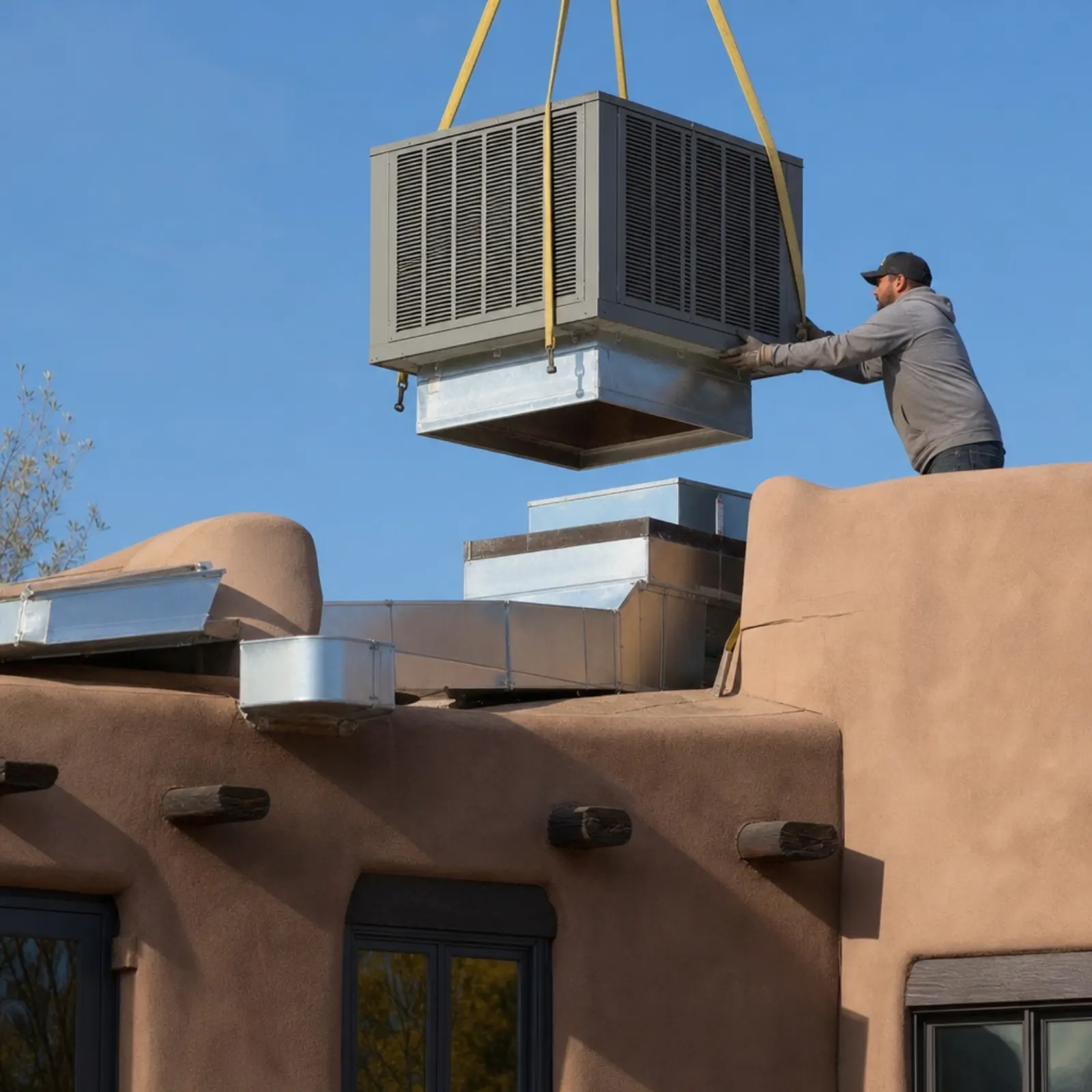
A spring swamp cooler start-up in Albuquerque costs $120 to $250, plus pads ($80 to $200 for aspen, $300 to $700 for rigid media), and it is the visit that decides whether your summer has a breakdown in it. The pan gets cleaned, pads installed, blower bearings oiled, belt tensioned, float set, water line and shutoff checked, and every speed tested. Book it in April, before the first hot week fills every schedule in the metro.
The start-up is not a courtesy visit. It is the one time a year someone looks at every wear part on the roof before the cooler has to run 12 hours a day.
When to start up, by neighborhood
The National Weather Service office in Albuquerque publishes the freeze data that sets this date, and it is not one date for the metro. The average last spring freeze at the Sunport is April 7. In Corrales, on the valley floor, it is April 25. The NWS explains why: on calm nights the valley floor can be 10 degrees or more colder than the Sunport, which itself runs several degrees warmer than the foothills, and the growing season shrinks from 210 days at the airport to 161 in Corrales.
So the practical calendar is:
- Northeast Heights, the University area, the Westside mesa: second week of April onward.
- North Valley, South Valley, Corrales, Los Lunas, Belen: last week of April, or start earlier and be ready to drain the line if a freeze is forecast.
- Placitas, at 5,955 feet on the north slope of the Sandias: treat it like the valley and watch the forecast.
Starting late costs nothing but a warm week. Starting early and leaving the line full through one cold night costs a split line and a flooded roof.
What the start-up actually covers
- Cover off, panels off, full inspection. Pads, pan, pump, float, distribution tubes, belt, motor, capacitor, bearings, controls, water line, shutoff. We are looking for what the winter did and what is going to fail in August.
- Pan cleaned. Last season’s scale and sediment come out. On Albuquerque water, roughly 8.2 grains per gallon by third-party compilations of the Water Authority’s 2024 zone reports, a pan that was not drained in the fall has a crust in it that will kill the new pump.
- New pads. Aspen every season. Rigid media every three to five seasons, inspected in between. Pads cut to the cooler’s frame, not folded to fit.
- Pump checked or replaced. Screen cleaned, impeller checked, flow verified to every distribution tube. A pump that is weak in April is dead in July; you get told, with a price ($150 to $400 installed).
- Float set. Water level set so the pan fills without running the overflow. A float that overfills sends water down the stucco all summer.
- Bearings oiled. The blower wheel shaft bearings take a few drops of oil and they take it every spring. This is the step homeowners skip and the reason motors seize in June.
- Belt tensioned. Too loose squeals and glazes; too tight eats the motor bearings. Belt replaced if cracked ($40 to $100).
- Water line and shutoff tested. Water on slowly, line checked for the winter split, shutoff confirmed working so you can kill it fast on a cold night or when the float fails.
- Bleed-off or purge pump set. The small stream that keeps pan minerals from concentrating. On hard water it is the difference between one set of pads a year and two.
- Every speed tested. Pump only, low, high. Damper opened, window relief checked, air at the vents confirmed cold.
What the start-up finds
The roof tells a story every April. The split water line from a skipped fall shutdown, the pan rusted through because it held water all winter, the pads that were left in and grew mold, the belt that cracked, the motor with dry bearings that hums and does not spin. All of those are cheaper in April than in June, and all of them are diagnosed on this visit with a price from the published table. A cooler that is genuinely done, rusted through or with a blower housing that is failing, gets an honest replacement number instead of a repair that buys one more season.
The Albuquerque-specific checks
Scale. This is hard-water country. City water averages about 8.2 grains per gallon, Rio Rancho’s aquifer water tests around 10.5, and Corrales and much of Placitas are on private wells with no softening. The start-up is when the bleed-off gets set and the pump screen gets cleaned, because scale is what every summer breakdown grows from.
The damper. Houses with both a cooler and refrigerated air, common in the Heights where a second system was added to a 1960s Mossman-Gladden house, need the down-duct damper opened for the cooler and sealed for the AC. A damper left half-open leaks conditioned air all summer.
The window relief. A cooler needs somewhere for the air to go. The start-up confirms a window or relief damper is open enough that the house is not pressurized, because a sealed house with a running cooler is a humid house.
Rentals. Since ordinance O-24-59 was enacted on January 2, 2025, the Uniform Housing Code requires every dwelling unit to be provided with cooling facilities, and evaporative coolers are named first among the acceptable permanently attached fixtures. For a landlord with coolers on several roofs, an April start-up round is the cheapest way to be in compliance before the first tenant complaint.
Start-up and shutdown as a package
The fall shutdown ($100 to $200) is often bundled with the start-up, and it is worth asking us about. The two visits together cost less than the split water line and dead pump that a skipped shutdown produces, and when we drained the cooler in October, we know exactly what to check in April.
Booking
Start-ups are scheduled visits, and the schedule fills in the first hot week of May every year without exception. Book in April. Send a photo of the cooler and the roof access, note whether you want aspen or rigid media, and mention if the cooler had any problems last season. You get a time and a number from the pricing page. We cover Albuquerque and out to Bernalillo, Los Lunas, and Belen; the FAQ covers the rest.
Frequently Asked Questions
How much does a swamp cooler start-up cost in Albuquerque?
$120 to $250 for the service, with pads priced separately: aspen $80 to $200 a set, rigid media $300 to $700. The visit includes cleaning the pan, installing pads, oiling the blower bearings, checking belt tension, setting the float, checking the water line and shutoff, and testing pump-only, low, and high. It is often packaged with the fall shutdown.
When should I start my cooler in Albuquerque?
After the average last freeze, which the National Weather Service puts at April 7 at the Sunport and April 25 in Corrales and the rest of the valley floor. If you start it early and a cold night is forecast, shut the water off and drain the line that evening. The latest freeze on record at the Sunport was May 27, 1918, so nothing is guaranteed, but mid-to-late April is the working window.
Can I do the start-up myself?
If you are comfortable on the roof, yes, and our fall shutdown checklist works in reverse. What homeowners skip is oiling the bearings, setting the float so it does not overflow, and checking the pump against the pad size. A missed bearing is how a $60 job becomes a $500 motor. If the roof is steep or two stories, hire it.
Why did my cooler flood the roof the first time I turned the water on?
The water line split over the winter because the cooler was not drained. The valley floor sees its first freeze around October 17 to 24 and can run 10 degrees or more colder than the Sunport on a calm night. That split is the most common spring repair, and it is fixed with the start-up visit; a fall shutdown at $100 to $200 prevents it.
More swampcooler services
Areas we serve
- Albuquerque, NM
- Edgewood
- Los Ranchos
- North Valley
- South Valley
- Swamp Cooler Repair in Belen, New Mexico
- Swamp Cooler Repair in Bernalillo, New Mexico
- Swamp Cooler Repair in Corrales, New Mexico
- Swamp Cooler Repair in Los Lunas, New Mexico
- Swamp Cooler Repair in Placitas, New Mexico
- Swamp Cooler Repair in Rio Rancho, New Mexico
- Tijeras